
You know something is wrong with the course. You cannot name it yet.
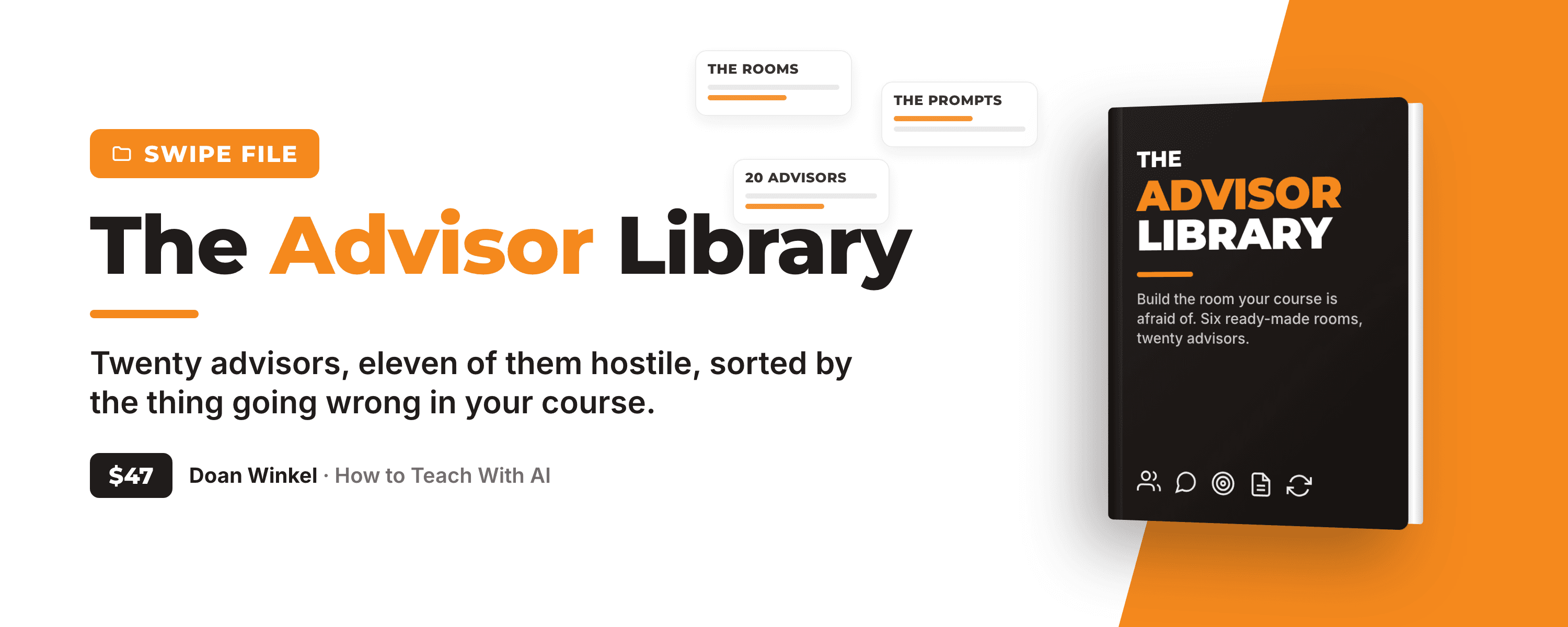
Six rooms of five advisors each, sorted by the failure instead of the document. Match your complaint to a room, paste in your material, and get back three ranked changes, a rewritten document, and a changelog, in about ten minutes.
Yours forever. Delivered the second you pay.
Three teachers this was built for
The Library is sorted by complaint, so start with yours.
The complaint collector
"Half the group did nothing." "The whole class turned in the same essay." "Grading takes nine hours." You can quote the failure word for word; you just cannot see its cause from inside the course.
The hour bleeder
Your course costs you more evenings than it should and you have never once run the arithmetic on where they go. The Labor Room exists for you, and it shows its math.
The Vault graduate
You ran a board on your syllabus and want the next level: rooms tuned to one specific failure each, plus the templates to build advisors and rooms of your own.
It was not built for teachers who want validation. Eleven of the twenty advisors are hostile by design, each with a named blind spot, because a room that agrees with you finds nothing.
Who is selling you this
I am a professor of entrepreneurship at John Carroll University and the Founding Director of the Bill & Sue Donnelly School of Leadership and Social Innovation. I cofounded the Experiential Entrepreneurship Curriculum, used at about 200 colleges. More than 20,000 teachers read my newsletter, How to Teach With AI.
The Library ships with two complete worked runs on real material: the Access Room on a 48-student group project sheet, and the Labor Room on a 62-student response-paper course that was eating nine hours a week. That second run found three changes returning roughly 64, 24, and 16 hours per term, with the arithmetic shown.
You diagnose your course by vibes.
The complaint is specific. The diagnosis never is. You google the symptom and get a listicle. You ask a colleague and get their course, not yours. You attend the workshop and get principles.
So the group project keeps producing one furious A student and three coasters, the rubric keeps rewarding padding, and the nine-hour grading week keeps arriving, because nobody ever sat with your actual document and argued about what it does.
The failure stays unnamed, and an unnamed failure gets a generic fix.
Pick the room that matches the complaint.
Each room is one copy-paste prompt that convenes five named advisors around one kind of failure: Access (who is locked out), AI (does the assignment survive a chatbot), Measurement (what the rubric actually rewards), Retention (what is gone by April), Labor (what it costs you, in hours), and Formation (what kind of person the course produces).
The advisors argue in three rounds, first takes with no groupthink, then attacks by name, then convergence. You get each voice's unfiltered read, the room's six diagnostic questions answered, and the disagreements that stayed contested, which tells you which recommendation is load-bearing and which is a guess.
Every room ends the same way: three ranked changes with the advisor who forced each one, the one thing worth defending as-is, your document rewritten, and a changelog.
First run, about ten minutes
- 1
Find your complaint in the matching table. Eleven common ones are mapped to rooms, so "the whole class turned in the same essay" points you straight at the AI Room.
- 2
Open ChatGPT, Claude, Gemini, or Copilot and paste the room prompt.
- 3
Fill in the brackets with your real document: the project sheet, the rubric, the assignment.
- 4
Read the argument, then the three ranked changes and the rewrite. Keep what survives your judgment.
Sixty seconds to convene the room, about ten minutes of argument. No paid AI account, nothing installed.
What is inside
Six complete rooms, the full advisor roster, the templates to build your own, and two worked runs on real material.
The Access Room
Who your course quietly locks out. First-gen student, disability services coordinator, working adult learner, Susan Cain, and Asao Inoue read your document as the students who struggle with it.
The AI Room
Whether the assignment survives a chatbot. Cal Newport, Sal Khan, Maryanne Wolf, Bryan Caplan, and a future employer fight about what is worth assigning at all.
The Measurement Room
What your rubric actually rewards, including the lazy maximum-grade strategy. An assessment specialist, an accreditation reviewer, Inoue, Grant Wiggins, and Carol Dweck.
The Retention Room
What students still carry in April. Robert Bjork, Daniel Willingham, Wiggins, Dee Fink, and Caplan on what your course design makes memorable versus merely covered.
The Labor Room
What the course costs you, in hours, with the arithmetic shown. Its ninth output is hours saved per ranked change, so the recommendation comes with a number attached.
The Formation Room
What kind of person the course produces. Mark Edmundson, the future employer, Caplan, Fink, and Dweck on the question syllabi never ask out loud.
The 20 advisor profiles
Every advisor in full: who they are, how they think, their biases, voice, what they challenge, their named blind spot, and a condensed paste block. Eleven are hostile by design.
Build your own
A room template, an advisor template with the three tests a profile must pass, a worked custom advisor built in four minutes, and seven advisor fights worth engineering on purpose.
What this will not do
It will not diagnose what you refuse to paste in. The rooms read your real document, and a vague summary of the assignment gets you a vague argument about it.
It will not always be right. Advisors have named blind spots on purpose, and some of their attacks you will read and reject. The "what stayed contested" section exists so you can see which conclusions the room itself was unsure of.
And you do not need all six rooms this month. Match one complaint, run one room, make one of the three changes. The other rooms keep.
Questions people ask before buying
How do I get it?
Checkout runs through Stripe. The second you pay, you land on the Library itself, a page you bookmark and keep forever. Lose the link and one email to doan@betterteacherwithai.com gets it back.
What do I need to run a room?
Any chat AI you already use: ChatGPT, Claude, Gemini, or Copilot, free accounts included. The rooms are plain-text prompts; you paste, fill brackets, and send.
How is this different from the Prompt Vault?
The Vault is sorted by document: syllabus prompt, rubric prompt, exam prompt. The Library is sorted by failure, with rooms built to find one specific thing, plus the templates to build rooms and advisors of your own. They complement each other; neither requires the other.
I don't recognize these advisor names. Does that matter?
No. Every profile explains who the advisor is and why they are in the room, and their arguments stand on their own. The hostile ones matter most, and hostility needs no introduction.
Why $47?
The Labor Room's worked run alone found changes worth about a hundred instructor hours per term on one course. If one room finds you one of those, the price stops being a question.
Six rooms, twenty advisor profiles, the build-your-own templates, the complaint-matching table, and two full worked runs. Yours forever, on every course you teach from here on.
Get the Advisor LibrarySecure checkout through Stripe. You get it immediately after payment.
This is also included in Better Teacher with AI Pro, along with the app, the workflow hub, and every other system I have built, from $29 a month.
See the Pro tiersThe complaint is not going away
Next term the same group project produces the same furious A student, the same rubric rewards the same padding, and the same nine-hour week arrives on schedule, because nothing about the course changed.
Or you spend ten minutes tonight letting five people argue about your actual document, and you walk away with three ranked changes and the reasoning behind each one.
You already know the complaint. There is a room for it.
Get the Library for $47